AI-Generated Influencers: Why Brands Are Turning Synthetic People Into Social Media Sales Tools
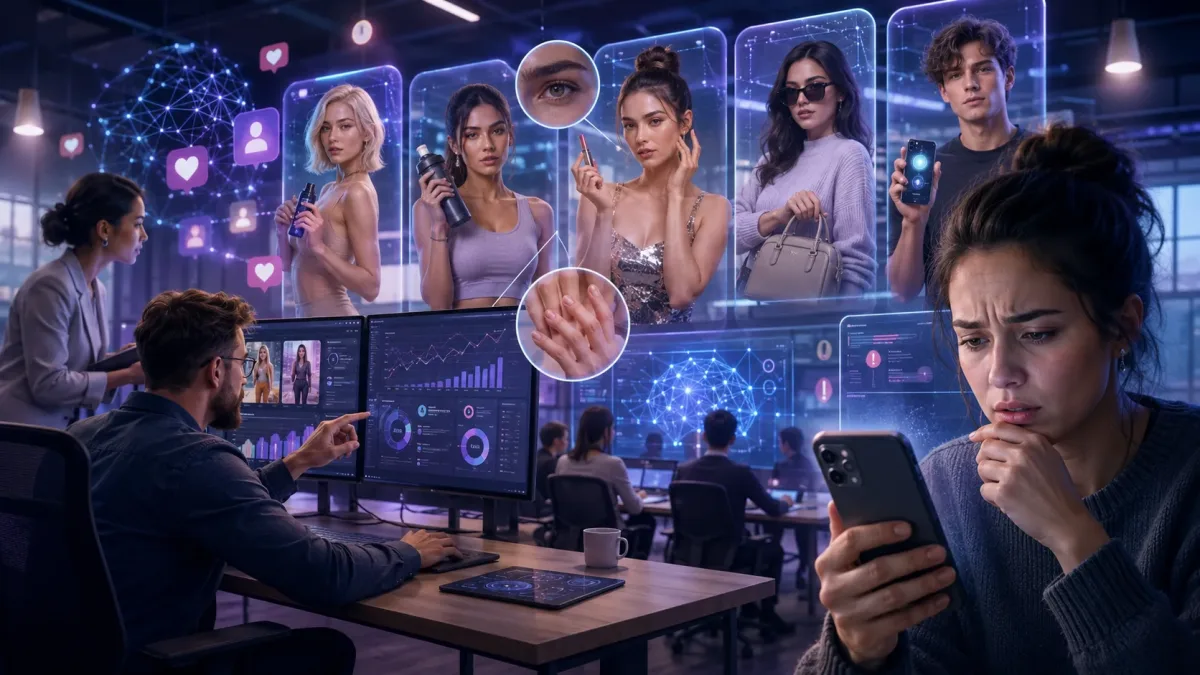
AI-generated influencers are becoming a new frontier in social media marketing, as brands experiment with synthetic personalities that look like real customers, creators or lifestyle models. The trend is raising difficult questions about transparency, consumer trust and the future of digital advertising.
A recent investigation found examples of promotional content that appeared to show genuine customer experiences, while analysis suggested some of the people featured were likely created using artificial intelligence. The issue is not simply that brands are using AI visuals. The deeper concern is that synthetic content can imitate authentic user-generated content without making that clear to audiences.
For marketers, AI-generated influencers offer speed, scalability and lower production costs. For consumers, they create a more complex online environment where it may be harder to tell whether a product recommendation comes from a real person, a paid creator, a synthetic avatar or a fully controlled advertising campaign.
AI-Generated Influencers: Key Details at a Glance
| Main Issue | Brands using synthetic influencers and AI-made customer-style content in social media advertising |
|---|---|
| Core Concern | Consumers may not realise that apparently real people in promotional posts are AI-generated |
| Business Motivation | Lower production costs, faster content creation, fewer risks linked to human influencers and scalable campaign testing |
| Regulatory Gap | UK advertising rules focus on whether ads are misleading, but do not currently impose a broad AI-content labelling rule |
| Technology Impact | AI is reshaping influencer marketing, user-generated content, brand trust and digital advertising workflows |
What Are AI-Generated Influencers?
AI-generated influencers are digital characters or hyperrealistic synthetic people created using artificial intelligence tools. They may appear in images or videos promoting products, demonstrating apps, wearing clothes, reviewing beauty items, unboxing purchases or describing lifestyle experiences.
Unlike traditional influencers, these figures do not have a real-world personal life, independent opinions or human limitations. A brand or agency can control their appearance, voice, location, tone and behaviour. That level of control is attractive to companies, but it also removes many of the signals audiences normally use to judge authenticity.
The most controversial use case is when AI content is designed to look like ordinary user-generated content. A video may appear to show a satisfied bride praising a wedding app, a homeowner demonstrating an interior design tool or a shopper reacting to a product. If that person is synthetic and the content is not labelled, consumers may believe they are watching a real customer experience.
Why Brands Are Using AI Influencers
The commercial logic is easy to understand. Traditional content production can be expensive. Brands may need photographers, studios, locations, models, stylists, editors and campaign teams. Human influencers can also bring reputational risk, scheduling problems, contract negotiations and inconsistent creative output.
AI-generated influencers reduce some of those barriers. A campaign can be tested quickly, adapted across multiple demographics and refreshed without organising a new photoshoot. A single synthetic character can be placed in different settings, wearing different products or speaking to different audience segments.
Lower Costs and Faster Testing
For startups and smaller brands, AI content can make polished advertising more accessible. Instead of spending heavily on production, a business can test creative concepts, product hooks and social media formats at lower cost. This helps explain why some companies treat AI influencer content as an experimental marketing tool rather than a full replacement for human creators.
The risk is that efficiency may come at the expense of trust. If customers later discover that a supposedly authentic testimonial was generated by AI, they may feel misled, even if the product itself is real.
More Control Over Brand Messaging
AI influencers also give brands greater control over messaging. A synthetic personality will not make an off-brand comment, become involved in a public scandal or negotiate higher rates after a campaign performs well. For companies that want predictable, repeatable creative output, this is a major advantage.
However, that same control is precisely what makes disclosure important. A real influencer, even when paid, has some human identity and public accountability. A synthetic influencer is a marketing asset. Audiences should be able to understand that difference.
The User-Generated Content Problem
User-generated content, often called UGC, became powerful because it felt more natural than polished advertising. A customer filming a product on a phone, reacting to a purchase or explaining how they use an app can seem more relatable than a traditional brand campaign.
AI-generated UGC-style advertising blurs that line. It can mimic the visual language of authenticity while being fully planned, produced and controlled by a brand or agency. That creates a trust problem for social platforms and advertisers.
If audiences cannot reliably distinguish between real customers and synthetic customers, the value of social proof weakens. Reviews, testimonials, unboxing videos and influencer-style recommendations all rely on the assumption that a genuine person is sharing some form of lived experience. AI makes that assumption less safe.
Why Transparency Matters
The debate is not whether brands should be banned from using AI-generated influencers. AI can be a legitimate creative tool. It can help small businesses produce campaigns, support rapid design testing and reduce production waste. The issue is whether the use of synthetic people should be clearly disclosed when they appear to represent real human experience.
Transparency allows consumers to evaluate advertising honestly. A user may still enjoy an AI-made campaign or buy the product being promoted. But they should not be led to believe that a synthetic testimonial is a genuine customer reaction.
This is especially important for sectors where trust is central, such as health, finance, beauty, childcare, education and high-value purchases. In those categories, fake realism can become more than a marketing gimmick. It can influence decisions that carry personal, financial or emotional consequences.
The Regulatory Gap in AI Advertising
UK advertising regulation currently focuses on whether advertising is misleading, socially responsible and clearly identifiable as marketing. There is not yet a broad rule requiring every AI-generated promotional image or video to be labelled simply because AI was used.
That creates a grey area. A brand may argue that a synthetic model is just another form of creative production. A consumer group may argue that a realistic AI influencer presented as a customer experience should be labelled because it changes how viewers interpret the message.
The European Union is moving towards stronger transparency obligations under the AI Act, including requirements around certain AI-generated or manipulated content. The UK has not adopted the same framework, leaving brands and regulators to navigate AI advertising through existing consumer protection and advertising standards.
Business Impact: Trust Becomes a Competitive Advantage
Brands that use AI-generated influencers without clear disclosure may gain short-term marketing efficiency, but they risk long-term reputational damage. As consumers become more aware of synthetic media, hidden AI use could be interpreted as deception rather than innovation.
The smarter strategy is likely to be transparent experimentation. Brands can use AI avatars, virtual models and synthetic content while making the nature of the content clear. This allows companies to benefit from AI creativity without undermining customer trust.
For agencies, the growth of AI influencers creates a new service category. Businesses will need help with synthetic content production, disclosure policies, brand safety checks, deepfake risk management and platform compliance. AI marketing will not remove the need for strategy; it will make governance more important.
Technology Impact: Detection Will Become a Marketing Tool
As synthetic media becomes more convincing, deepfake detection and content provenance systems will become more valuable. Brands may need to prove not only that a campaign is effective, but also that it is transparent and compliant.
This could create demand for AI-detection tools, watermarking systems, content credentials and audit trails. Marketing teams may need records showing when AI was used, what assets were generated, whether a human likeness was involved and how disclosures were applied.
In future, responsible AI advertising may require a workflow similar to data protection compliance: documentation, approvals, risk assessment and clear accountability.
Balanced Analysis: Innovation or Manipulation?
AI-generated influencer marketing sits between creative innovation and potential manipulation. On one side, it offers genuine business advantages. Brands can create campaigns faster, reduce costs, test ideas and reach audiences with highly tailored content. For startups, this can lower barriers to professional marketing.
On the other side, the technology can manufacture the appearance of social proof. A synthetic customer can cry at a wedding, react to a product, praise an app or model clothing without ever having used anything. That is powerful, but it is also ethically sensitive.
The distinction should be simple: AI-generated promotional content can be acceptable when audiences are not misled about what they are seeing. The more closely AI content imitates real customer experience, the stronger the case for clear labelling becomes.
What Brands Should Do Now
Businesses using AI influencers should treat transparency as part of brand safety. That means creating internal policies before campaigns go live, not after a backlash begins.
Brands should decide when AI use must be disclosed, how synthetic people are described, whether AI-generated testimonials are allowed and who approves high-risk content. They should also avoid presenting fictional customer experiences as real endorsements.
Marketing teams should work with legal, compliance and technology teams to build clear rules. As regulation develops, companies that already have responsible AI advertising policies will be better prepared.
Final Takeaway: Synthetic Influence Needs Real Accountability
AI-generated influencers are not a passing novelty. They are part of a wider transformation in digital marketing, where generative AI is changing how campaigns are produced, tested and scaled.
The technology can be useful, creative and commercially valuable. But when synthetic people are used to imitate real customers, brands enter a trust-sensitive area. Consumers deserve to know when the person recommending a product is not a person at all.
The next phase of influencer marketing will not be defined only by who can create the most realistic avatar. It will be defined by which brands can use AI creatively while remaining honest with their audiences. In a market flooded with synthetic content, transparency may become the strongest form of influence.
More AI and Technology Coverage
For more analysis on artificial intelligence, automation and digital transformation, explore AgizoAI’s latest coverage on AI guides, AI tools and coding prompts.

Published by
AgizoAI Editorial Team
AI news, prompt engineering, tool reviews and practical technology coverage from the AgizoAI editorial desk.
Continue reading
Related AI stories
ChatPlayground AI Review 2026: Compare ChatGPT, Claude, Gemini and More for $15 a Month
Our ChatPlayground AI review examines how the $15/month multi-model platform compares ChatGPT, Claude, Gemini, Perplexity and more side by side — and…

EU AI Act 2026 Deadline: What Website Owners and AI Tool Users Should Know
The EU AI Act 2026 deadline is coming. Website owners and AI tool users should prepare with disclosure, labelling, vendor review and…

How to Combine AI, Human Editing and SEO for a Better Website
Learn how to combine AI, human editing and SEO to create better website content with stronger quality, trust, structure and search performance.