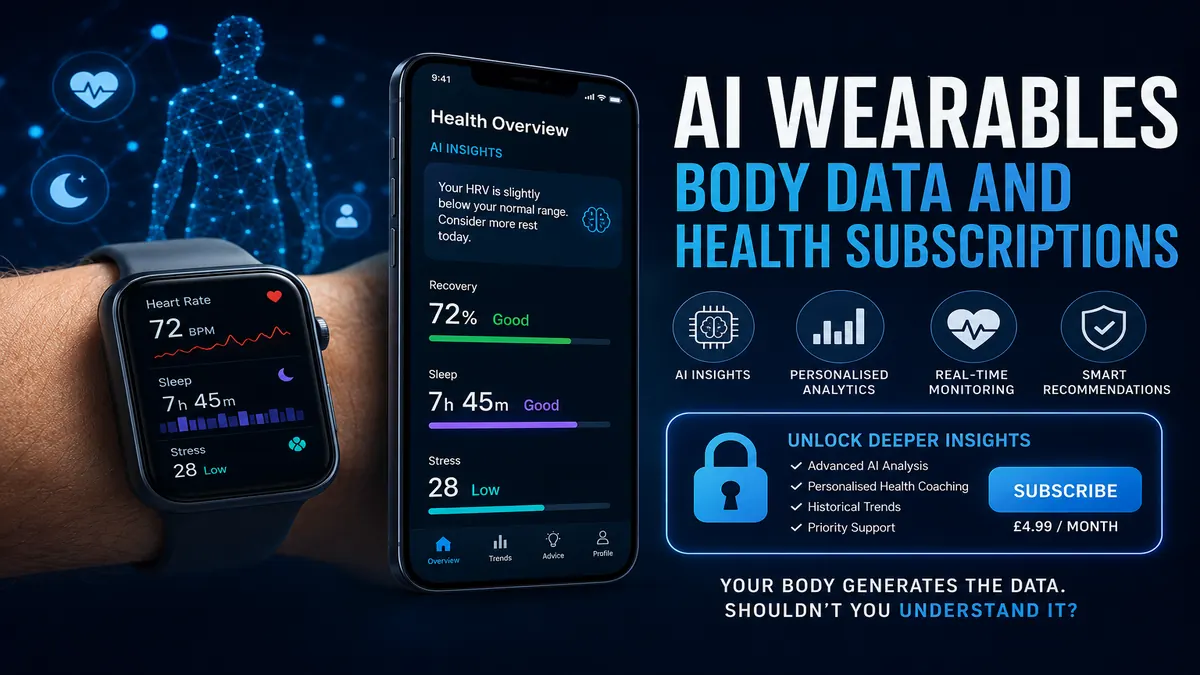
AI wearables are no longer just fitness gadgets that count steps or record sleep. They are becoming intelligent health companions capable of analysing heart rate, stress, recovery and personal body data. As smartwatches, fitness trackers and smart rings become more advanced, a bigger question is emerging: will users soon have to pay a monthly subscription to understand their own bodies?
For more than a decade, wearable devices have quietly collected information about the way people live. They know how much we move, how long we rest, how often our heart rate changes and whether our daily routines are helping or harming our health. Until recently, however, much of that information remained little more than numbers on a screen.
The arrival of artificial intelligence is changing that. Instead of simply recording data, AI wearables are beginning to interpret it. They are being designed to explain what the body may be signalling, suggest lifestyle changes and turn raw health statistics into personalised advice.
How AI Wearables Are Changing Health Tracking
The first wave of wearable technology was based on simple tracking. Devices counted steps, estimated calories and logged workouts. Later models added sleep scores, blood oxygen readings, heart-rate variability, temperature trends and stress monitoring.
These features made health data more visible, but they did not always make it easier to understand. A low sleep score can tell someone they had a poor night, but it does not always explain why. A higher resting heart rate could suggest stress, fatigue, illness or poor recovery, but the average user may not know what action to take.
This is where AI wearables become more important. By combining several signals at once, artificial intelligence can look for patterns that may be missed by a standard fitness tracker. It can connect sleep, exercise, stress, recovery and routine behaviour to produce more useful insights.
In simple terms, the device is no longer only telling the user what happened. It is trying to explain what it may mean.
From Fitness Trackers to Personal Health Assistants
The next generation of wearable devices is moving closer to the idea of a personal health assistant. A smartwatch or smart ring may notice that poor sleep follows late-night screen use, that recovery drops after intense training, or that stress levels rise at the same time each week.
Instead of leaving the user to interpret graphs alone, an AI-powered system could provide clearer guidance. It may suggest a lighter workout, recommend more rest, highlight a repeated stress pattern or encourage the user to seek professional advice if something appears unusual.
This shift is part of the wider growth of AI tools designed to make everyday decisions more personalised. Health, fitness and wellness are becoming major areas for this type of technology because the data is continuous, personal and highly valuable.
For athletes, AI wearables could help manage training load and recovery. For busy professionals, they may help detect early signs of fatigue or burnout. For older users, they could provide useful alerts when daily health patterns change unexpectedly.
Why AI Wearables Could Become Subscription Services
The commercial model behind wearable technology is also changing. In the past, many users bought a device once and expected the main features to be included. Today, the most valuable part of the product is often not the hardware, but the software behind it.
Advanced health analysis, AI coaching, cloud processing and personalised recommendations all require ongoing development. For technology companies, that makes subscriptions attractive. Instead of selling only a watch or ring, they can sell continuous access to deeper health insights.
For users, this raises a more sensitive question. A person buys the wearable. They wear it day and night. Their own body generates the data. Yet the most useful interpretation of that data may sit behind a monthly payment.
This is why AI wearables could become controversial. People are used to paying for streaming, cloud storage and productivity software. Paying to understand sleep, stress, recovery and health signals may feel far more personal.
The issue is not only cost. It is ownership. If the body creates the data, should users have to keep paying to access meaningful insight from it?
The Privacy Risk Behind Wearable Health Data
Wearable health data is extremely personal. A device worn throughout the day and night can reveal sleep habits, exercise routines, stress patterns, possible illness signals and lifestyle changes. When artificial intelligence is added, the system does not only collect information; it begins to interpret it.
That creates serious privacy concerns. Users need to know who can access their data, how long it is stored, whether it can be used to improve AI systems and whether it may be shared with third parties.
The more advanced AI wearables become, the more trust they will need to earn. Clear privacy settings, transparent data policies and strong user control will become essential. A device that helps people understand their health can be valuable. A device that appears to monetise sensitive body data without enough clarity will quickly lose public confidence.
Are AI Wearables the Future of Personal Health?
The promise of AI wearables is significant. They could help people make better decisions about sleep, exercise, recovery and stress. They could also make health data easier to understand for people who are not medical or fitness experts.
However, there is also a risk of over-monitoring. When every part of life becomes a score, health can start to feel like a performance target. Sleep becomes a score. Recovery becomes a score. Stress becomes a score. Even rest can begin to feel like something that must be optimised.
For some users, this may be motivating. For others, it may create anxiety. A poor sleep score in the morning can shape the mood of an entire day. A low readiness score may discourage exercise even when the person feels fine.
This is why the tone of AI health advice matters. Wearable devices should guide people without making them feel controlled by their own data. They should explain uncertainty, avoid unnecessary alarm and encourage healthy habits in a realistic way.
AI Wearables, Body Data and the Subscription Economy
The future of AI wearables will depend on trust. These devices could become useful personal health companions, helping users understand their bodies with more clarity. They may support better routines, earlier warnings and more informed choices.
But the same technology could also become another subscription trap. Users may pay for the device, pay again for the insights and slowly become dependent on a platform to interpret their own body signals.
This is the central tension. A wearable that says, “You seem tired today; here is how to recover,” feels helpful. A wearable that says, “Pay to unlock what your body is trying to tell you,” feels very different.
The body is becoming one of the next major digital platforms. That may bring real benefits, but it also raises important questions about privacy, ownership and access. If body data becomes one of the most valuable forms of personal information, users must know who controls it, who profits from it and whether understanding their own health should come with a monthly fee.
FAQ: AI Wearables and Body Data
What are AI wearables?
AI wearables are smart devices such as watches, rings and fitness trackers that use artificial intelligence to analyse health, fitness and body data.
How do AI wearables use body data?
AI wearables can analyse sleep, heart rate, stress, recovery and activity patterns to provide personalised health insights.
Will AI wearables require subscriptions?
Some wearable technology companies are moving towards subscription models because advanced AI insights, cloud processing and personalised health analysis require ongoing software support.
Are AI wearables safe for privacy?
AI wearables collect sensitive personal health data, so users should check privacy settings, data-sharing policies and subscription terms before using them.
Can AI wearables replace doctors?
No. AI wearables can support personal health awareness, but they should not replace professional medical advice, diagnosis or treatment.

Published by
AgizoAI Editorial Team
AI news, prompt engineering, tool reviews and practical technology coverage from the AgizoAI editorial desk.
Continue reading
Related AI stories

AI in 2026: Current Status of Artificial Intelligence and What Comes Next
Artificial intelligence in 2026 is moving beyond chatbots into agents, infrastructure, enterprise adoption and regulation. Here is where AI stands now and…