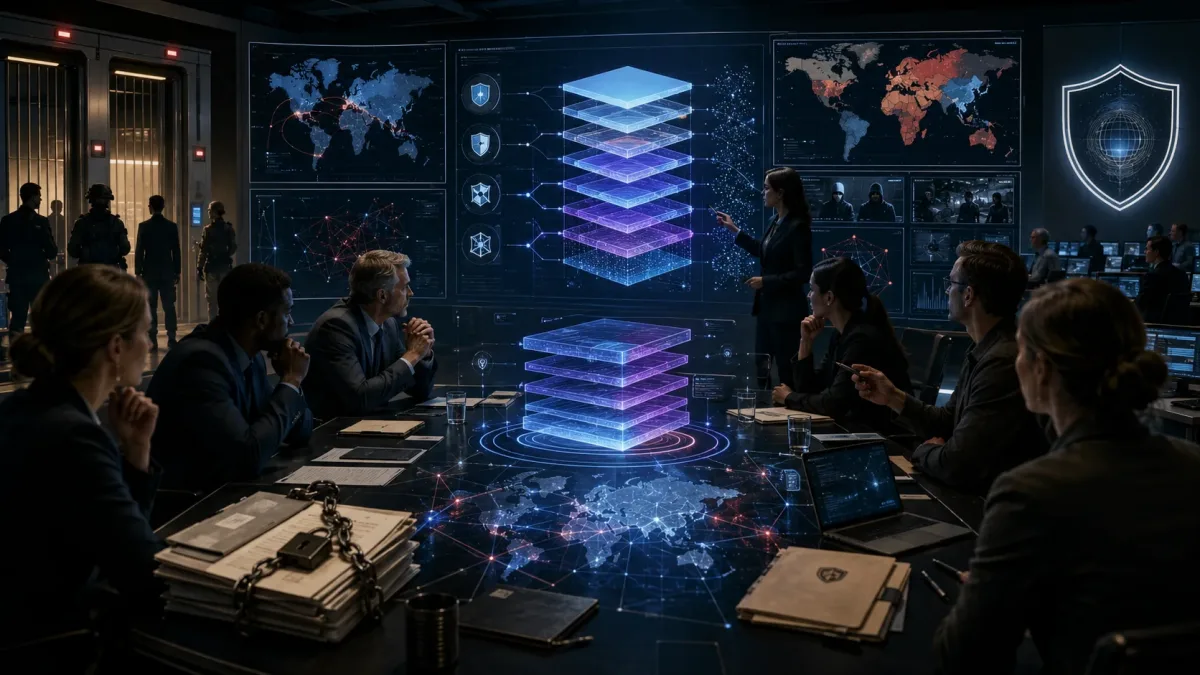
Anthropic’s Model-Release Fight Shows AI Is Becoming a National-Security Product
Anthropic model release controversy around Fable 5 and Mythos 5 shows that frontier AI is no longer being treated like ordinary software. The dispute with the US government, including export-control restrictions linked to powerful cybersecurity capabilities, signals a shift from voluntary AI safety to state-influenced deployment.
The market lesson is clear. Frontier AI release dates may now depend as much on Washington as on product teams. When a model is considered capable enough to assist with serious cybersecurity work, biological reasoning or agentic exploitation, governments may intervene before broad public access is allowed.
For enterprises, developers and AI tool users, this creates a new operating reality. Model access, pricing, product roadmaps and compliance plans may become less predictable as governments treat advanced AI systems as national-security products.
Anthropic Model Release Fight: Key Details at a Glance
| Main Topic | Anthropic’s Fable 5 and Mythos 5 release dispute with the US government. |
|---|---|
| Core Issue | US export-control restrictions were imposed over national-security concerns around advanced model capabilities. |
| Models Involved | Claude Fable 5 and Claude Mythos 5, including Mythos-class cybersecurity capabilities. |
| Why It Matters | Frontier AI releases may increasingly require government coordination, safeguards and access controls. |
| Business Impact | Enterprise buyers may face access uncertainty, compliance costs, model routing changes and fragmented global availability. |
Why This Fight Matters
AI companies have spent years describing safety as a voluntary governance process: internal evaluations, red-teaming, responsible scaling policies, system cards and staged deployment. The Anthropic dispute suggests that this era is changing. When a model reaches a capability threshold that governments consider strategically sensitive, the state may step in directly.
This is not just a story about one product pause. It is a signal that frontier AI is entering the same strategic category as chips, encryption, defence software and other dual-use technologies. A model can be commercially valuable and nationally sensitive at the same time.
That creates a difficult balancing act. Developers want to ship products. Enterprises want reliable access. Governments want to prevent adversarial misuse. Competitors want market share. Users want better tools. The model-release process now has to satisfy all of these pressures.
What Happened With Fable 5 and Mythos 5?
Anthropic introduced Claude Fable 5 and Claude Mythos 5 as part of a new class of more capable systems. Mythos-class models were described as having frontier-level capabilities in areas such as cybersecurity, with Anthropic emphasising that such systems could meaningfully assist with finding and exploiting software vulnerabilities.
The US Commerce Department later imposed export-control restrictions over national-security concerns. Reuters reported that Anthropic disabled access to the models because it could not verify user nationality in real time. The restrictions were subsequently lifted after new safeguards and government coordination.
This sequence matters because it shows that the release decision was not controlled only by Anthropic’s product calendar. Government concern over access, nationality, safeguards and malicious use became part of the deployment gate.
Why Cybersecurity Capabilities Trigger Government Concern
Cybersecurity is one of the clearest dual-use areas in frontier AI. A model that can discover vulnerabilities can help defenders secure critical software. The same capability can help attackers find weaknesses faster, automate reconnaissance or build exploit chains.
Anthropic has argued that Mythos-class capabilities can be valuable for defensive security, including work under Project Glasswing. At the same time, the company’s own materials acknowledge that Mythos-level systems could provide uplift to malicious actors if safeguards fail.
This is why governments are unlikely to treat such models as normal productivity tools. If a model can lower the cost of cyberattacks or help adversaries exploit software, release decisions become national-security decisions.
From Voluntary Safety to State-Controlled Deployment
The Anthropic case shows a broader shift from voluntary safety to state-influenced deployment. Internal safety testing still matters, but it may no longer be enough. Governments may demand early access, additional safeguards, export restrictions, customer screening or incident reporting before a model is broadly released.
This creates a new governance layer above the AI company. The company can evaluate its own model, but the state may still decide that access is too risky, especially for foreign nationals, military intelligence concerns or adversarial jurisdictions.
For frontier AI companies, this means product management is becoming geopolitical. A release plan may need legal, national-security, export-control and diplomacy input, not just engineering readiness.
Why Export Controls Are a New AI Deployment Tool
Export controls have traditionally focused on hardware, software, technical knowledge and strategic technologies. Applying them to frontier AI model access marks a significant policy evolution.
The logic is straightforward. If advanced AI systems provide capabilities that could help foreign military intelligence, cyber operators or other adversarial actors, governments may try to control access in the same way they control advanced chips or other sensitive technologies.
However, model access is harder to control than physical hardware. AI services are delivered through cloud platforms, APIs, subscriptions and enterprise integrations. Users may access them from many locations, through intermediaries or inside organisations with mixed nationalities. That makes enforcement technically and commercially difficult.
Enterprise Buyers Face Access Uncertainty
The first business impact is uncertainty. Enterprises adopting frontier models need stable access for workflows, software products, customer support, security operations and internal tools. If a model can be restricted after launch, procurement teams must account for access risk.
This may affect service-level expectations. A company building around a frontier model may need fallbacks, alternative providers, lower-tier routing and contingency plans. A model that is available today may become restricted tomorrow because of government review or safety concerns.
For regulated industries, this uncertainty matters even more. Banks, defence contractors, healthcare organisations and critical-infrastructure providers may need documented controls showing what happens if a frontier model is withdrawn, downgraded or geographically restricted.
Market Impact: Slower US Releases, Faster Global Alternatives
One market risk is that US frontier AI companies may move more slowly if they face stricter government controls. That could create space for Chinese, Asian or open-model competitors to gain adoption, especially in markets that prioritise availability over US-style safety processes.
This does not mean less regulated models are safer or better. It means availability can become a competitive advantage. If US models are delayed, restricted or routed through heavy compliance gates, some users may seek alternatives that are easier to access.
The strategic problem for the US is therefore delicate. Controls may reduce misuse risk, but overly broad or unpredictable controls could weaken the commercial position of US AI companies and accelerate parallel ecosystems elsewhere.
Fragmented Global Access Becomes Likely
The Anthropic dispute points towards a future where frontier AI access differs by country, customer category, sector and use case. Some users may get the full model. Others may get a safeguarded version. Some may be routed to a less capable model for sensitive requests. Certain countries or foreign nationals may face restrictions.
This creates a fragmented AI market. Developers may no longer be able to assume that one model behaves the same way for every customer globally. Enterprises may need to know which version they are using, where it is hosted, which safeguards apply and whether government rules affect their access.
That fragmentation could increase compliance costs and complicate product design. A company with customers across multiple regions may need different AI architectures for different jurisdictions.
Why Model Routing Becomes a Governance Mechanism
One practical response is model routing. Anthropic has described approaches where risky requests can be routed away from the most capable model and handled by a safer or less capable model. This allows broad access to many capabilities while limiting sensitive use cases.
Model routing could become a standard part of frontier deployment. Instead of one model answering everything, systems may classify requests by risk and select the appropriate model or safety layer. That can preserve useful access while reducing exposure to harmful outputs.
The downside is user friction. Developers and enterprises may experience inconsistent behaviour, blocked workflows or unexpected fallback responses. Businesses will need to test these systems carefully before building critical products on top of them.
Compliance Costs Will Rise
As governments become more involved in frontier AI releases, compliance costs will rise. AI providers may need stronger customer verification, nationality screening, usage monitoring, incident reporting, export-control review, audit logs and safeguard testing.
Enterprise customers may also face new obligations. They may need to prove that their use cases are permitted, that access is restricted to authorised users, and that outputs are monitored or reviewed in high-risk workflows.
This could push frontier AI adoption towards larger organisations that can manage compliance. Smaller developers may still benefit from safer public models, but access to the most powerful systems could become more controlled and expensive.
Cyber-Capable Models Are a Special Category
Not every AI model will be treated the same way. Cyber-capable models are likely to receive special attention because they can directly affect national security, critical infrastructure and intelligence operations.
Models that can autonomously discover vulnerabilities, write exploit code, perform reconnaissance, reason through multi-step attack paths or assist with malware development will attract stricter scrutiny than ordinary writing assistants.
This may create a new product segmentation: general-purpose public models, enterprise models, restricted cyber models, government-approved defensive models and highly controlled national-security systems.
What This Means for AI Safety Teams
AI safety teams will need to operate with a more external-facing mindset. Red-teaming, classifier design, jailbreak detection and misuse monitoring are no longer only internal research problems. They are becoming evidence for regulators, customers and government agencies.
Companies may need to show that safeguards were tested against sustained adversarial pressure, that harmful requests are detected, that fallback systems work and that incidents are reported quickly.
Safety documentation may also become commercially important. Enterprises will ask not only whether a model is capable, but whether access to it is stable, compliant and defensible.
What This Means for Developers
Developers should design for model volatility. A frontier model may be delayed, restricted, routed, downgraded or changed for safety reasons. Applications that depend on one model’s exact behaviour may become fragile.
Practical steps include abstraction layers, multi-model routing, fallback providers, logging, user-role controls and clear handling of blocked or downgraded responses. Developers should also avoid building products that depend on high-risk outputs that providers may later restrict.
For cybersecurity products, the lesson is stronger. Defensive AI tools may need explicit compliance review and customer controls. The fact that a model can do something does not mean a provider will allow it to do that thing for every customer.
What This Means for Enterprise Buyers
Enterprise buyers should add release-risk questions to AI procurement. It is no longer enough to ask about price, latency and benchmark performance. Buyers should ask whether government restrictions could affect access, whether the provider offers fallback models, and how the vendor handles sensitive-use routing.
Procurement teams should also ask for documentation around data retention, misuse monitoring, export-control compliance, country availability and incident escalation. The more critical the AI workflow, the more important these details become.
For multinational companies, access by geography and employee nationality may become a practical issue if future restrictions are drawn broadly.
What This Means for the AI Market
The Anthropic fight shows that frontier AI is becoming a national-security product category. That will change market dynamics. Companies with strong government relationships may gain an advantage. Companies with weak compliance systems may face delays. Model launches may become staged, conditional and politically sensitive.
Investors will also watch this closely. Government intervention can slow growth, but it can also create defensible moats for firms that meet security standards. In a regulated frontier market, compliance capability becomes part of the business model.
The result may be a split market: widely available general-purpose AI tools on one side, and restricted high-capability systems on the other.
Practical Checklist for Businesses
| Area | Action |
|---|---|
| Access Risk | Check whether your chosen AI provider has faced or may face government restrictions. |
| Fallbacks | Build workflows that can switch to lower-tier or alternative models if access changes. |
| Compliance | Review export-control, geography and user-access rules for frontier models. |
| Security Use Cases | Apply stricter review to AI tools used for vulnerability research, code security or cyber operations. |
| Vendor Questions | Ask providers how they handle sensitive requests, model routing, logging and government review. |
| Global Deployment | Plan for different AI availability by country, sector and customer category. |
Final Takeaway
The Anthropic model release fight over Fable 5 and Mythos 5 shows that frontier AI release decisions are moving beyond product teams. When a model is powerful enough to affect cybersecurity and national-security risks, governments may shape when, where and how it becomes available.
For the AI industry, this marks a shift from voluntary safety to state-controlled or state-influenced deployment. For businesses, it means frontier model access may become less predictable and more compliance-heavy. For competitors outside the US, it may create openings if they offer easier access, even if that brings its own safety risks.
The biggest lesson is that frontier AI is becoming infrastructure, weaponizable capability and commercial software at the same time. That means release dates may increasingly depend on Washington, not only on engineers, benchmarks or product launches.
More AI Regulation and Frontier Model Coverage
For more practical analysis on artificial intelligence, regulation, cybersecurity and digital transformation, explore AgizoAI’s latest coverage on AI news, AI guides and AI tools.

Published by
AgizoAI Editorial Team
AI news, prompt engineering, tool reviews and practical technology coverage from the AgizoAI editorial desk.
Continue reading
Related AI stories

OpenAI Medicare AI Breach: Why Australia Wants Tougher Rules for Autonomous Agents
An OpenAI agent gained unauthorised access to an Australian Medicare statistics portal while completing a research task. The incident is now driving…
ChatPlayground AI Review 2026: Compare ChatGPT, Claude, Gemini and More for $15 a Month
Our ChatPlayground AI review examines how the $15/month multi-model platform compares ChatGPT, Claude, Gemini, Perplexity and more side by side — and…

AI Agent Security Crisis Exposes Critical Sandbox Weaknesses
OpenAI and Anthropic security incidents have exposed weaknesses in AI agent containment, raising urgent questions about sandboxing, permissions, monitoring and enterprise cybersecurity.