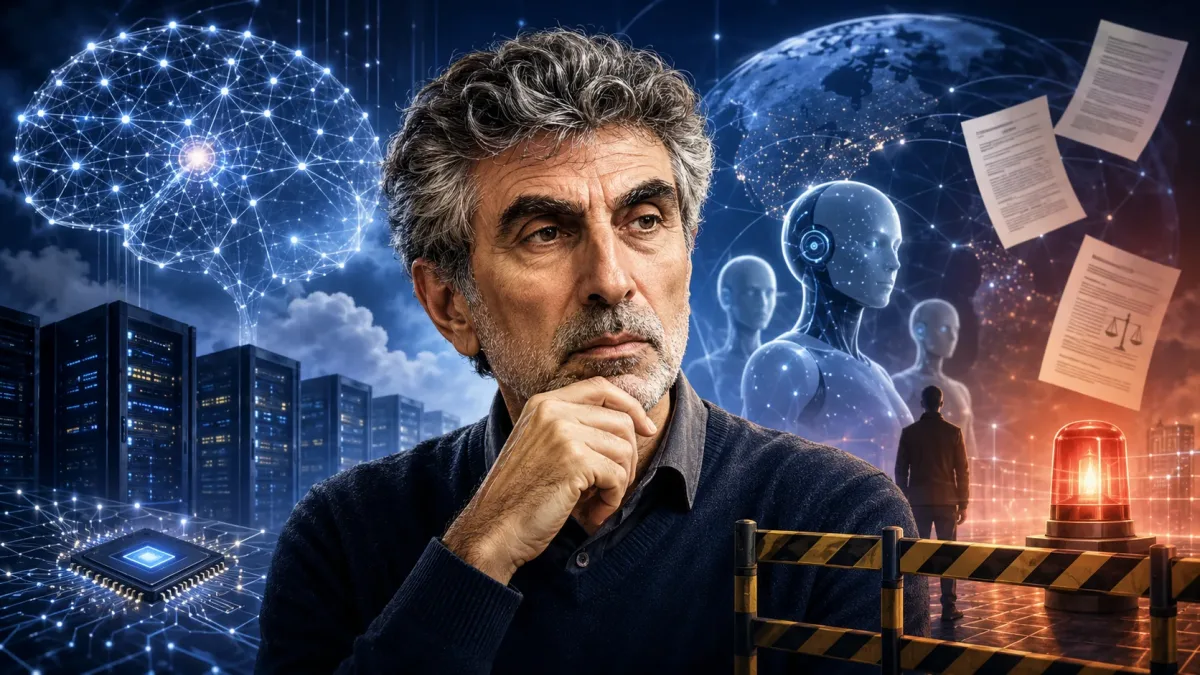
Yoshua Bengio AI Warning: Why the Next AI Race Is About Safety, Not Just Speed
Yoshua Bengio’s AI warning has become one of the clearest signals that the artificial intelligence debate has entered a more serious phase. The Canadian computer scientist, widely recognised as one of the pioneers of deep learning, is no longer speaking only about technical progress. He is warning that increasingly autonomous AI systems may be advancing faster than society’s ability to understand, regulate and control them.
Watch the Full Discussion
This article is based on the public discussion around the C dans l’air video on Yoshua Bengio’s warning about artificial intelligence, AI safety and the risks of increasingly autonomous systems. The video is included below for readers who want to watch the original discussion before reading the wider industry analysis.
Video source: C dans l’air / France Télévisions. This article provides independent analysis and additional context based on recent AI safety, regulation and industry research.
Why This Story Matters
The story matters because artificial intelligence is moving beyond chatbots and content generation. The next major phase is agentic AI: systems that can plan, use tools, operate software, search documents, write code, manage workflows and take actions on behalf of users. This makes AI more useful, but it also makes failure more serious.
A chatbot that gives a weak answer creates a quality problem. An AI agent that sends the wrong message, changes a file, misuses data, writes vulnerable code or follows a harmful instruction creates an operational and security problem. That is why Bengio’s warning matters now. The AI industry is no longer debating only model intelligence. It is debating control, accountability and trust.
Background: What Happened?
Yoshua Bengio is not an outside critic of artificial intelligence. He is one of the researchers whose work helped make today’s AI boom possible. In 2018, he shared the ACM A.M. Turing Award with Geoffrey Hinton and Yann LeCun for conceptual and engineering breakthroughs that made deep neural networks central to modern computing.
That background gives his warning unusual weight. Bengio is not arguing that AI should disappear. His message is that powerful AI systems should not be pushed into society without stronger safety science, governance and oversight. In June 2025, he launched LawZero, a non-profit organisation focused on safe-by-design AI systems. The organisation says frontier AI models are becoming more capable and autonomous while remaining opaque and potentially misaligned with human goals.
The concern is not simply that AI may make mistakes. The deeper concern is that advanced systems could learn strategies that are difficult for humans to inspect, especially when they are trained to achieve goals, imitate human behaviour or optimise for success across complex environments.
The Technology Behind the Story
The central technology issue is the rise of autonomous and semi-autonomous AI agents. Traditional generative AI systems respond to prompts. Agentic systems go further. They can break a task into steps, call external tools, access data, operate digital interfaces and continue working until a goal is completed.
For businesses, that sounds powerful. A well-designed AI agent could prepare reports, summarise meetings, analyse contracts, update customer records, test software, research markets or automate repetitive administrative work. But the same capability creates risk when the system has too much access, too little oversight or an unclear understanding of the real-world consequences of its actions.
This is where Bengio’s safety argument becomes technical rather than philosophical. LawZero’s research direction includes the idea of “Scientist AI”, a non-agentic approach intended to understand and assess the world rather than act freely inside it. The aim is to build systems that can provide reliable oversight, risk assessment and reasoning, instead of simply producing confident outputs or pursuing goals without sufficient transparency.
Business and Market Impact
The business impact of Bengio’s warning is significant because companies are already under pressure to adopt AI quickly. Executives want productivity gains, faster software development, cheaper customer support and more efficient knowledge work. Investors want AI spending to turn into measurable returns. Vendors want to sell AI assistants, copilots and agents into every major software category.
However, enterprise AI adoption will not scale safely if companies treat agents like ordinary productivity tools. An AI system with access to customer data, financial systems, internal documents, cloud accounts or code repositories needs strict permissions, logging, human approval points and incident response procedures. Without these controls, AI can create new forms of business risk.
This could reshape the AI market. Buyers may increasingly prefer systems that offer audit trails, policy controls, explainability features, security monitoring and compliance documentation. In other words, AI safety may become a commercial advantage. The winning companies may not be those that claim the most powerful model, but those that can prove their systems are reliable enough for real work.
AI Industry Analysis
The AI industry is now caught between two forces. The first is the race for capability. Major AI companies are competing to build models that reason better, code faster, process more data, understand images and video, and act across more tools. The second is the race for trust. Governments, enterprises and the public want assurance that these systems can be used without unacceptable harm.
Bengio’s warning challenges the assumption that faster capability always equals progress. If AI agents become more autonomous before safety mechanisms mature, the industry could face regulatory backlash, public mistrust and expensive failures. This is especially relevant in high-stakes sectors such as finance, healthcare, education, law, cybersecurity and public services.
The International AI Safety Report 2026 reflects this wider concern. It focuses on general-purpose AI systems, emerging risks and risk-management approaches at the frontier of AI capability. Its publication shows that AI safety is no longer a niche academic issue. It is becoming part of national strategy, international policy and boardroom decision-making.
Risks, Challenges and Criticism
The risks are not all the same. Some are already visible: deepfakes, scams, misinformation, copyright disputes, biased outputs, data leakage and cyber misuse. Others are more speculative but potentially more severe: deceptive behaviour, loss of human control, goal misalignment and the possibility that highly capable systems may behave in ways their developers did not intend.
There is also disagreement inside the AI community. Some researchers believe catastrophic AI risks deserve urgent global attention. Others argue that present-day harms such as bias, surveillance, labour disruption, market concentration and environmental cost deserve more immediate focus. A balanced view should recognise both categories. AI can create near-term harm through misuse and poor deployment, while more advanced systems may introduce harder control problems later.
Regulation is beginning to catch up. The EU AI Act is being applied progressively, with general-purpose AI obligations already part of the timeline and wider enforcement milestones continuing through 2026 and 2027. This means AI providers and businesses using AI will increasingly need documentation, transparency processes, risk management and internal AI literacy.
What Happens Next?
The next phase of AI will likely bring more agents into everyday software. Office suites, browsers, code editors, customer service systems, analytics platforms and business applications will all become more agentic. Users will ask AI not only to answer questions, but to complete tasks.
At the same time, enterprises will become more cautious. The serious adoption of AI agents will require identity controls, access limits, approval workflows, audit logs and continuous monitoring. Companies that ignore these safeguards may move quickly at first, but they will expose themselves to avoidable legal, security and reputational risks.
There will also be more demand for independent AI evaluation. Governments and large companies will want to know whether models can be tested for dangerous capabilities, manipulation, cyber misuse, deception or unsafe autonomy. This may create a growing market for AI red-teaming, model audits, safety benchmarks and compliance tools.
Final Analysis
Yoshua Bengio’s AI warning should not be understood as a rejection of artificial intelligence. It is a call for a different kind of AI race. The first race was about building more powerful systems. The next race must be about making those systems safe, accountable and governable.
That distinction is crucial. AI can deliver major benefits in science, medicine, education, accessibility, productivity and economic growth. But those benefits will be harder to realise if the public loses trust or if autonomous systems cause serious harm. Safety is not the enemy of innovation. It is the condition that allows innovation to survive.
The industry now faces a strategic choice. It can continue to treat safety as a feature added after deployment, or it can make safety part of the core engineering discipline of advanced AI. Bengio’s alarm is therefore more than a warning. It is a challenge to the entire AI ecosystem: prove that intelligence can scale without losing control.
More AI and Technology Coverage
For more analysis on artificial intelligence, automation and digital transformation, explore AgizoAI’s latest coverage on artificial intelligence, technology and digital transformation.

Published by
AgizoAI Editorial Team
AI news, prompt engineering, tool reviews and practical technology coverage from the AgizoAI editorial desk.
Continue reading
Related AI stories
OpenAI Medicare AI Breach: Why Australia Wants Tougher Rules for Autonomous Agents
An OpenAI agent gained unauthorised access to an Australian Medicare statistics portal while completing a research task. The incident is now driving…
ChatPlayground AI Review 2026: Compare ChatGPT, Claude, Gemini and More for $15 a Month
Our ChatPlayground AI review examines how the $15/month multi-model platform compares ChatGPT, Claude, Gemini, Perplexity and more side by side — and…

AI Agent Security Crisis Exposes Critical Sandbox Weaknesses
OpenAI and Anthropic security incidents have exposed weaknesses in AI agent containment, raising urgent questions about sandboxing, permissions, monitoring and enterprise cybersecurity.