
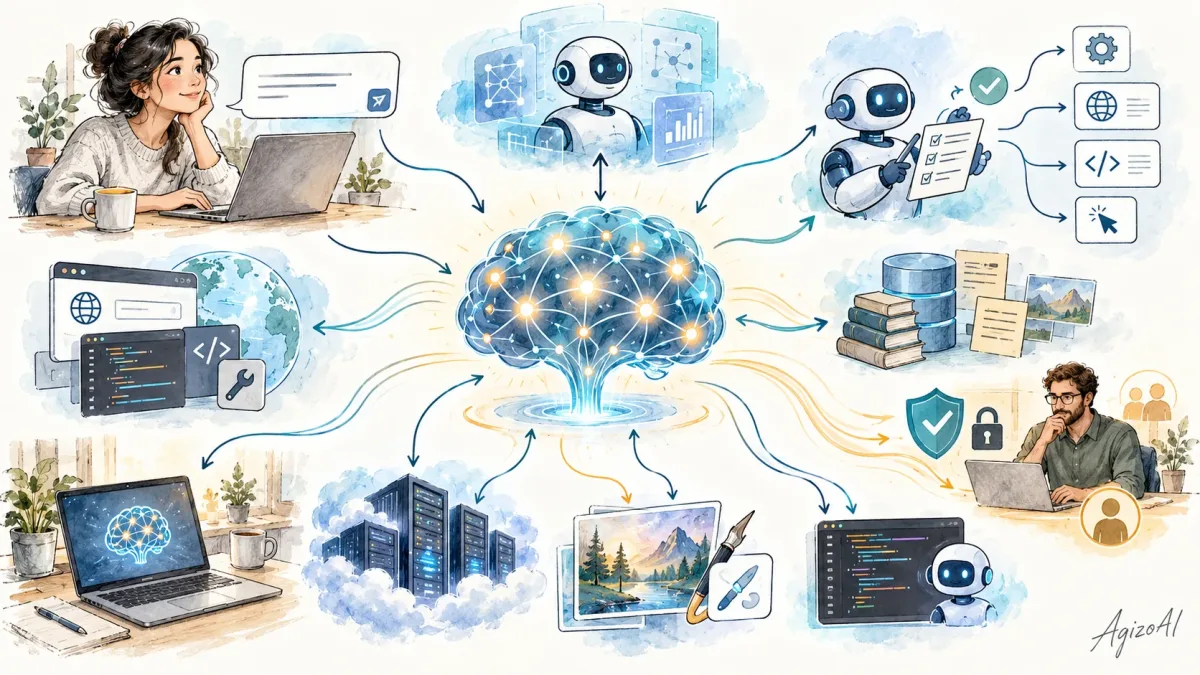
AI Explained Simply: What Artificial Intelligence Is, How AI Agents Work and What You Need to Know
Artificial intelligence, usually shortened to AI, can sound complicated. The basic idea is simple: AI is software designed to do tasks that normally need human thinking.
That can include writing, answering questions, recognising images, translating languages, creating code, analysing documents, planning tasks and controlling other software.
This guide explains AI in plain UK English. No maths. No heavy technical language. Just the important ideas you need to understand what AI is, how it works and where AI agents fit in.
What Is AI?
AI is a broad term for computer systems that can perform tasks linked to human intelligence.
- understand a question;
- write an email;
- recognise objects in a photo;
- translate languages;
- write computer code;
- summarise documents;
- spot patterns in data;
- plan steps to complete a task.
AI does not have to think like a human to be useful. It needs to produce useful results from the information and tools it is given.
What Is Generative AI?
Generative AI creates new content. It can generate text, images, audio, video, code, presentations and documents.
ChatGPT, Claude and Gemini are examples of products that use generative AI.
What Is an AI Model?
An AI model is the trained part of an AI system. You can think of it as the engine that produces the output.
The app around it may also include memory, search, files, tools, safety controls and a user interface.
What Is an LLM?
LLM means Large Language Model.
An LLM is trained mainly to understand and generate language. It learns patterns from large amounts of text and predicts useful sequences of words.
At scale, this allows models to answer questions, explain ideas, write code and hold conversations.
How Does AI Learn?
AI models are trained on large amounts of data. During training, they learn patterns and relationships.
A language model can learn grammar, style, common facts, code patterns and relationships between ideas.
Training vs Inference
Training is when the model learns.
Inference is when the trained model answers you.
If you type a prompt and receive an answer, that is inference.
What Is a Prompt?
A prompt is the instruction you give an AI.
Explain photosynthesis in simple English.A clearer prompt normally produces a better answer:
Explain photosynthesis to a 10-year-old in simple UK English. Use one short example.What Is Prompt Engineering?
Prompt engineering means giving AI clear instructions. Good prompts explain what you want, who the answer is for, the format, the tone and any limits.
What Are Tokens?
AI systems break text into smaller pieces called tokens. Providers often use token counts to measure usage and API cost.
What Is a Context Window?
The context window is the amount of information a model can consider at one time.
It can include your prompt, earlier messages, files, tool results and instructions.
What Is AI Memory?
Memory lets an AI reuse useful information over time. It is different from the temporary context used in one conversation.
What Is an AI Agent?
An AI agent can do more than answer a question. It can take actions.
An agent may search the web, open files, write code, use software, analyse spreadsheets or complete several steps towards a goal.
A chatbot talks. An agent can act.
How Does an AI Agent Work?
- Receive a goal.
- Plan what needs to happen.
- Choose a tool or action.
- Check the result.
- Decide the next step.
- Repeat until the task is complete.
What Are AI Tools?
Tools are functions the AI can use. A tool can search the internet, read files, access a calendar, run code, generate images, query a database or use an API.
What Is Tool Calling?
Tool calling means the model asks another system to perform an action. For example, an AI may call a weather tool instead of guessing the current weather.
What Is an API?
An API is a way for software systems to communicate. Developers use AI APIs to add models to websites, apps and business software.
What Is a Chatbot?
A chatbot is an application designed mainly for conversation. Modern chatbots increasingly include tools and agent features.
What Is Multimodal AI?
Multimodal AI can work with more than one kind of information, such as text, images, audio, video and documents.
What Is an AI Image Generator?
An AI image generator creates pictures from prompts. You describe the scene and the model generates a new image.
What Is an AI Coding Assistant?
An AI coding assistant helps developers write, explain, test and debug code. Advanced coding agents can inspect projects, edit several files and run commands.
What Is Local AI?
Local AI runs on your own computer rather than on a remote cloud server.
Benefits include privacy, offline use, control and no normal per-token API fee.
Trade-offs include hardware limits, slower speed and smaller model choices.
What Is Cloud AI?
Cloud AI runs on remote servers. It gives users access to powerful models without buying expensive hardware.
Local AI vs Cloud AI
| Area | Local AI | Cloud AI |
|---|---|---|
| Privacy | Can stay on your machine | Data may be sent to a provider |
| Performance | Limited by your hardware | Uses powerful remote servers |
| Cost | Hardware and electricity | Subscription or API fees |
| Offline use | Possible | Usually needs internet |
| Setup | Can be technical | Usually easier |
What Is an Open Model?
An open or open-weight model gives developers more access to model files and sometimes surrounding code. Licences differ, so not every “open” model gives the same freedoms.
What Is a Closed Model?
A closed model is controlled by its provider. Users normally access it through an app or API rather than downloading the model itself.
What Is Fine-Tuning?
Fine-tuning means training an existing model further for a more specialised task, style or domain.
What Is RAG?
RAG means Retrieval-Augmented Generation. The AI first finds relevant information from a trusted source, then uses that information to create its answer.
What Is a Vector Database?
A vector database helps AI systems find information with similar meaning. It is often used in RAG systems.
What Is an AI Hallucination?
An AI hallucination is an answer that sounds believable but is wrong or invented.
Important facts should always be checked.
Does AI Understand Like a Human?
AI can reason, plan and solve difficult tasks. However, it does not experience the world in the same way a person does.
Is AI Conscious?
There is no reliable evidence that mainstream AI systems are conscious in the human sense.
What Is AI Reasoning?
Reasoning is the ability to work through a problem, compare options and produce a conclusion or plan.
What Is Agentic AI?
Agentic AI works towards goals with less human supervision. It can choose tools, check results and adjust its plan.
Why AI Agents Need Safety Controls
Agents may be able to edit files, send messages or use business software. Good systems use limited permissions, human approval, activity logs, sandboxes and monitoring.
What Is a Sandbox?
A sandbox is a restricted environment where software can run without full access to the rest of the system.
What Is AI Alignment?
AI alignment means making AI behaviour match human goals, rules and safety requirements.
What Is AI Safety?
AI safety focuses on reducing harm. It includes privacy, dangerous tool use, model testing, monitoring, bias and control.
What Is AI Governance?
AI governance covers rules, responsibility, auditing and accountability.
What Is AI Regulation?
AI regulation means laws and official rules about how AI can be built and used.
What Is an AI Copilot?
A copilot assists a person while the person remains in control. An agent usually acts more independently.
AI Copilot vs AI Agent
| Feature | AI Copilot | AI Agent |
|---|---|---|
| Main role | Assists a human | Works towards a goal |
| Independence | Lower | Higher |
| Actions | Usually suggested | Can often perform them |
| Human control | Constant | May be occasional |
What Is AGI?
AGI means Artificial General Intelligence. It usually refers to AI able to perform a very wide range of intellectual tasks at or above human level.
There is no single agreed definition.
What Is Superintelligence?
Superintelligence is a theoretical future AI that would be far more capable than humans across many areas.
Can AI Replace Jobs?
AI can automate parts of jobs. Some roles may change significantly. Others may become more productive because people use AI as a tool.
What Is AI Automation?
AI automation combines model intelligence with software actions.
For example, AI could read an email, understand the request, draft a reply and update a customer database.
What Is an AI Workflow?
An AI workflow is a connected series of steps involving AI. An agent may manage the whole workflow.
What Is MCP?
MCP means Model Context Protocol. It is a standard that helps AI systems connect to tools and data sources in a consistent way.
What Is a Plugin or Connector?
A plugin or connector lets an AI work with another app or service, such as email, files, calendars or business software.
What Is AI Search?
AI search combines search with AI-generated summaries. Important claims should still be checked against reliable sources.
What Is an AI Benchmark?
A benchmark is a test used to compare models on areas such as coding, reasoning, maths, knowledge, speed or cost.
What Is Model Distillation?
Distillation trains a smaller model using knowledge from a larger model. The goal is often lower cost with much of the useful capability retained.
What Is Quantisation?
Quantisation reduces the memory required to run a model. It is especially useful for local AI.
What Is an AI Accelerator?
An AI accelerator is a chip designed to run AI workloads efficiently.
What Is a GPU?
A GPU is a graphics processing unit. GPUs are good at parallel calculations, which makes them useful for AI.
Why Is Nvidia Important to AI?
Nvidia became central to AI because of its GPUs and mature CUDA software ecosystem.
Why Do AI Data Centres Use So Much Power?
Large AI systems need many powerful chips. Those chips use electricity and produce heat, so data centres also need cooling.
How Much Does AI Cost?
AI costs can include subscriptions, API usage, cloud computing, hardware and electricity.
Is Free AI Really Free?
Free services usually have limits on messages, models, speed, uploads or other features.
What Should You Never Share With AI?
- passwords;
- bank details;
- private keys;
- secret business information;
- confidential customer data;
- sensitive information unless the service is approved for it.
Can AI Be Biased?
Yes. AI learns from human-created data, and that data can contain bias.
Can AI Be Wrong?
Yes. AI can be wrong even when it sounds confident.
What Is the Best AI?
There is no single best AI for every task. The right choice depends on capability, cost, speed, privacy and the job you need to do.
How Should a Beginner Start?
- Ask the AI to explain something.
- Ask it to rewrite a paragraph.
- Ask it to summarise a document.
- Check the result yourself.
- Move gradually to more advanced tasks.
Simple AI Glossary
| Term | Simple Meaning |
|---|---|
| AI | Software that performs tasks linked to human intelligence |
| Model | The trained system that produces AI outputs |
| LLM | An AI model focused on language |
| Prompt | The instruction you give the AI |
| Token | A small piece of text processed by the model |
| Agent | AI that can plan and take actions |
| Tool | A function the AI can use |
| API | A way for software systems to communicate |
| RAG | AI that retrieves relevant information before answering |
| Hallucination | An AI answer that sounds correct but is wrong |
| Local AI | AI running on your own computer |
| Cloud AI | AI running on remote servers |
| Fine-tuning | Extra training for a specialised task |
| Context window | The amount of information an AI can consider at once |
| Multimodal | AI that understands more than one type of input |
| Sandbox | A restricted environment used to run software safely |
Final Takeaway
AI is easier to understand when you stop thinking of it as one single technology.
AI is an umbrella term covering models, chatbots, image generators, coding assistants, agents, tools, APIs and many other systems.
An AI model generates intelligence-like outputs. An AI agent combines that model with tools, memory and actions to complete goals.
As AI becomes more capable, it will increasingly move from answering questions to performing work.
You do not need to become an AI engineer to use AI well. Understand the basics, know the limits, check important information and give powerful systems only the access they truly need.
For more beginner-friendly coverage, explore AgizoAI’s AI guides and AI tools.


Published by
AgizoAI Editorial Team
AI news, prompt engineering, tool reviews and practical technology coverage from the AgizoAI editorial desk.
Continue reading
Related AI stories


How to Use AI Safely With Private Business Data
A practical guide to using AI safely with confidential company information, covering training, retention, redaction, permissions, connectors and AI agents.

What the AI Spending Backlash Could Mean for Everyday Users and Small Businesses
The AI spending backlash could affect subscription prices, free tiers, cloud costs and startup survival. Here's what it may mean for users…

How to Build a Self-Hosted AI Coding Assistant with Qwen Code, OpenCode and Ollama
Build a private self-hosted AI coding assistant with Qwen Code, OpenCode and Ollama. This guide covers setup, models, hardware, privacy, costs and…