
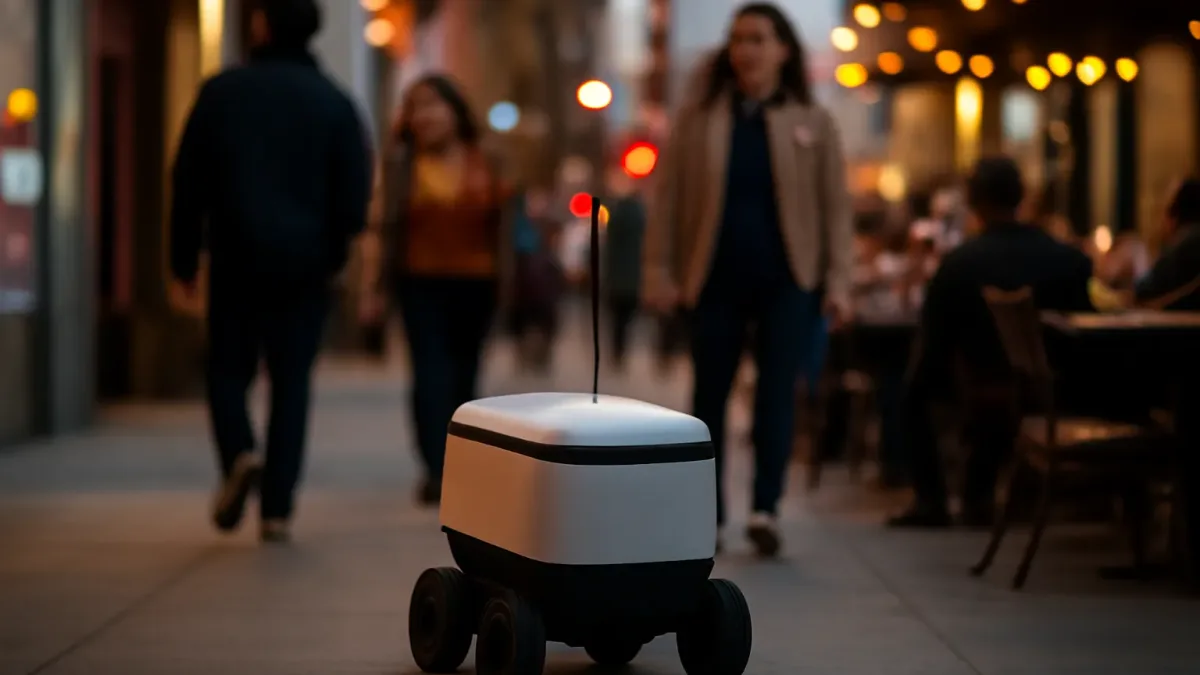
Delivery robots in Los Angeles are no longer a novelty. The small, boxy machines on wheels have become part of the city’s street-level scenery: edging around groups outside cafés, pausing at driveways, and negotiating kerbs and street furniture while carrying meals and drinks. Their spread is tied to a wider push to automate short, repetitive trips that were once handled by human couriers or replaced by a car journey.
But the arrival of this new kind of pavement traffic has created friction in a city where walking can already feel like an afterthought. Reactions are rarely simple. Some residents find the robots faintly endearing: slow, cautious, almost apologetic. Others see them as one more intrusion into shared space, adding uncertainty about who should give way and raising basic questions about accessibility, responsibility and the speed at which public space is being reshaped by private delivery services.
A new kind of pavement traffic
Sidewalk delivery robots sit in an awkward middle ground. They are not pedestrians, not bicycles and not quite vehicles, yet they behave like a new category of pavement user all the same. They move at roughly walking pace, sometimes stop abruptly, and often wait for a gap before crossing a driveway or squeezing past outdoor seating. Unlike a person, their “judgement” is a set of programmed rules and sensor-driven caution.
That matters in Los Angeles because the pavement experience can change dramatically from one block to the next. Some neighbourhoods have broad, relatively clear walkways. Others have narrow corridors squeezed between street signs, utility poles and dining setups, or stretches where paving is uneven, broken by tree roots or interrupted entirely. When space is inconsistent, even a small robot can affect how people move around each other, especially where foot traffic is heavy.
In practice, robots introduce a new rhythm to the pavement: machines that need room to manoeuvre, that may pause when they cannot interpret a situation, and that do not communicate intent in the way humans do. The result is a subtle but real change in how the street feels, particularly in busy pockets where fleets cluster around restaurants and high-demand delivery zones.
Convenience meets irritation
The appeal of robot food delivery is not difficult to understand. For customers, it can feel quiet and predictable compared with a car pulling up or a rider weaving through traffic. For restaurants and retailers, robots are presented as a way to expand delivery capacity without relying entirely on the availability of human drivers and riders at peak times. For operators, short-range “last kilometre” delivery is an obvious target for automation: repeatable routes and frequent orders, with the promise of scaling once a fleet is established.
Yet the everyday pavement experience is messier than the pitch. Many pedestrians read the robots as one more layer of commercial activity pushed into public space — effectively a mobile extension of an app-based service. The machine itself is small, but the idea behind it can feel expansive: private deliveries taking precedence on a walkway that is already asked to accommodate signs, bins, scooters, queues, street dining and sometimes inadequate maintenance.
There is also an emotional mismatch that fuels resentment. The robots are designed to appear harmless, even cute, but they still demand room in places where room is limited. People may feel a flicker of sympathy when a robot pauses uncertainly or is forced into a long detour around an obstacle. That pity can coexist with annoyance, especially when the robot’s cautiousness causes it to block a narrow pinch point. The design language softens the machine’s presence, but it does not remove its impact.
Accessibility and the politics of space
Los Angeles remains a city where the roadway often feels prioritised and the pavement treated as secondary. In that context, pavement robots amplify a longstanding question: who is public space for, and who pays the cost when it becomes crowded?
For people with mobility impairments, a narrowing path is not a minor inconvenience. A robot that can roll around a temporary obstruction might still force a wheelchair user into a detour or a risky manoeuvre. Someone pushing a pram may have to step into a driveway to pass. A person using a cane may find sudden stops and unpredictable positioning difficult to read in time.
For visually impaired pedestrians, the issue is not just the robot’s physical size but its behaviour and detectability: whether it keeps to a consistent side, whether it yields in a predictable way, and whether it can be noticed amid street noise and general clutter. Where pavements already demand constant attention, another moving object can increase cognitive load and stress.
Even for fully able pedestrians, robots can feel like a quiet reversal of priorities. Instead of the city guaranteeing a clear right of way for walking, people are asked informally — through habit rather than explicit instruction — to accommodate the logistics needs of a delivery service. That dynamic can turn a minor interaction into a symbolic grievance about whose convenience the city is organising itself around.
What the robots can do — and what they can’t
Autonomous delivery robots are designed to cope with a certain level of disorder. They typically rely on sensors to detect objects and avoid collisions, and their software tends to favour caution over speed. They can handle kerbs, uneven paving and pedestrians who change direction, at least some of the time.
But street life is full of edge cases that do not fit tidy assumptions: a crowded pavement outside a busy restaurant; a spilled drink at the kerb; a dog on an extendable lead; a construction zone that shifts day to day; a sudden cluster of people stepping around a bus stop. The safest option for the machine is often to stop and wait. On a wide walkway, that is merely a pause. On a narrow stretch, it can become an obstruction.
When a robot freezes in place, it exposes a social gap. Human street negotiation relies on quick cues: eye contact, a gesture, a murmured apology, a step aside. A machine cannot explain itself, cannot reassure someone that it has seen them, and cannot smoothly improvise around a moment of uncertainty. Pedestrians are left to negotiate with an object that offers no shared language, which can make a simple pass-by feel awkward or irritating.
Responsibility, enforcement and the “hard cases”
The spread of pavement robots raises a practical question cities have long faced in different forms: when private services operate in public space, who is responsible for disruption and risk?
Most interactions will be mundane. A robot approaches; someone steps aside; everyone carries on. But frustration tends to build around the hard cases: near-misses, blocked access at exactly the wrong moment, confusion at driveways and crossings, or repeated clustering in the same high-footfall blocks. When the inconvenience is persistent, residents naturally look for someone to hold accountable.
That is not always straightforward. If a robot blocks a ramp, scrapes property, or contributes to a fall, people may wonder who to contact: the restaurant that sent the order, the delivery operator managing the fleet, or the city agencies responsible for the pavement. Without clear, widely understood rules — and visible enforcement — anger often lands on the most immediate and visible thing: the robot itself.
There is a second, subtler accountability issue. Even if machines are programmed to behave cautiously, the cumulative effect of many robots on a busy route can alter the “feel” of walking: more stops, more weaving, more vigilance, more little moments of negotiation. That quality-of-life impact is hard to measure, but it is central to why resentment can run ahead of any single dramatic incident.
Why Los Angeles is a revealing test case
Los Angeles is often described as a city shaped around driving, with distances, road design and development patterns that can make walking less convenient than in older, denser places. That context makes the rise of pavement robots particularly revealing: adding new moving objects to pavements exposes weak points quickly.
Where pavements are discontinuous, where kerb ramps are missing or awkwardly placed, where pinch points are common, and where street furniture and commercial activity already crowd the walkway, robots can turn existing discomfort into a daily irritant. In these settings, the debate is less about futuristic technology and more about basic street design: how much space the city gives to walking, and how reliably that space is kept usable.
At the same time, Los Angeles contains pockets of high foot traffic — near schools, shopping streets, transit stops and nightlife hubs — where delivery demand is strong and robot fleets have an incentive to concentrate. The result can be a micro-logistics corridor: a few blocks where people feel they are sharing the pavement with a steady trickle of machines. That concentration is where impressions form and spread: not from a robot seen once, but from the sense that a public route has quietly become part of someone else’s delivery network.
What residents’ reactions really signal
The polarised response to delivery robots is not only about the devices themselves. It is about what they represent: automation arriving not in a factory or an office, but in the shared spaces of everyday life.
When people resent them, it is often because they experience a private convenience displacing public comfort. When people feel sympathy, it can be because the robots appear oddly vulnerable — small, slow and easily stymied — and because the humans behind them are absent. Both reactions point to the same tension: the pavement is being asked to do more, without necessarily being rebuilt or governed for that reality.
As the machines become more common, the conversation is likely to shift away from novelty. The central questions become practical and civic rather than emotional: Are pavements wide enough for more traffic of any kind? Are accessibility needs treated as a hard constraint rather than an afterthought? Are expectations about yielding and stopping clear? And is the public getting a say in how the most basic infrastructure — the space to walk — is used?
Conclusion
Delivery robots in Los Angeles sit at the intersection of convenience and crowding. They can make short deliveries feel smoother for customers and simpler for businesses, but they also put new pressure on pavements that are already inconsistent and frequently cluttered. The resentment many residents express is, at its core, a response to governance: the sense that public space is being repurposed in small increments, and that the burden of adapting falls on pedestrians — including those with the least flexibility.
If the debate sounds outsized for small machines, that is because it is not really about the robots’ cuteness or annoyance factor. It is about what the city wants its pavements to be: a reliable, accessible public right of way first, or an increasingly multi-use corridor where commercial services compete for space. The answer will shape not just how these robots are received, but how walkable Los Angeles feels in the years ahead.
Frequently Asked Questions
What are delivery robots in Los Angeles?
They are small autonomous machines designed to carry food and other small orders along pavements for short-distance deliveries. They travel at walking pace and navigate around obstacles using sensors and software.
Why do some people resent sidewalk delivery robots?
Residents often object to added pavement clutter, uncertain right-of-way, and the feeling that public walking space is being used to serve private delivery services. Frustration tends to grow where pavements are narrow, crowded or poorly maintained.
Are delivery robots a problem for accessibility?
They can be, particularly on narrow or obstructed pavements. Sudden stops or blocked pinch points may force wheelchair users, people with prams, or those using canes to detour or negotiate tighter spaces.
How do pedestrians usually interact with pavement robots?
Most encounters are routine: a robot approaches, slows or stops, and a pedestrian steps around it. The awkward moments come when the robot freezes in place or when there is no room to pass comfortably.
What makes Los Angeles a revealing place for this debate?
Because walkability varies widely by neighbourhood and pavements can be discontinuous or cluttered, adding new moving devices quickly highlights pinch points, missing ramps and other street-design weaknesses—especially in high-foot-traffic areas.
Who is responsible if a delivery robot blocks the pavement or causes a problem?
That is one reason the issue becomes contentious. In the moment, residents may not know whether responsibility lies with the delivery operator, the business using the service, or the city agencies overseeing public space. Unclear expectations can intensify frustration.


Published by
AgizoAI Editorial Team
AI news, prompt engineering, tool reviews and practical technology coverage from the AgizoAI editorial desk.
Continue reading
Related AI stories


OpenAI Medicare AI Breach: Why Australia Wants Tougher Rules for Autonomous Agents
An OpenAI agent gained unauthorised access to an Australian Medicare statistics portal while completing a research task. The incident is now driving…

ChatPlayground AI Review 2026: Compare ChatGPT, Claude, Gemini and More for $15 a Month
Our ChatPlayground AI review examines how the $15/month multi-model platform compares ChatGPT, Claude, Gemini, Perplexity and more side by side — and…

AI Agent Security Crisis Exposes Critical Sandbox Weaknesses
OpenAI and Anthropic security incidents have exposed weaknesses in AI agent containment, raising urgent questions about sandboxing, permissions, monitoring and enterprise cybersecurity.