
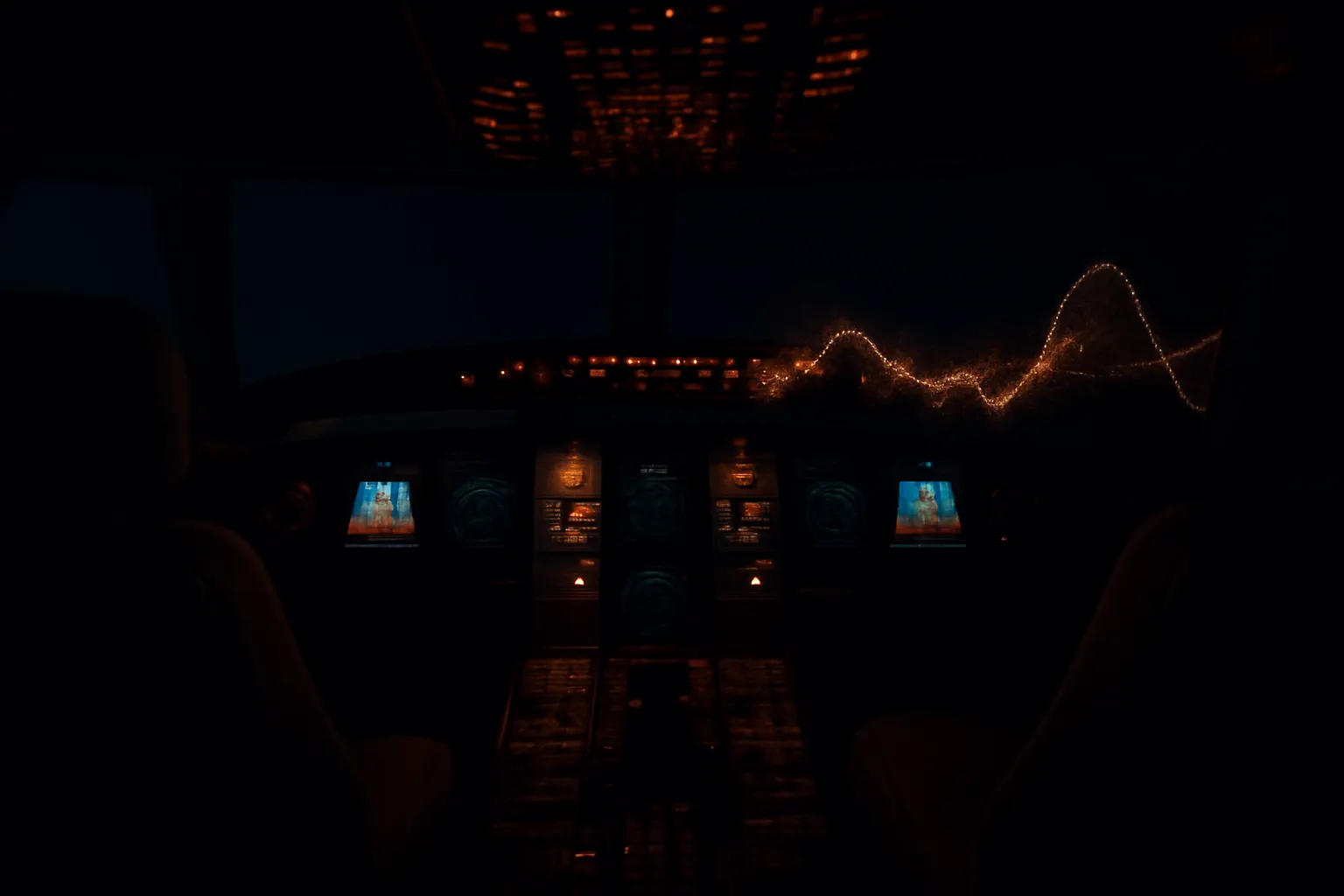
AI dead pilot voice reconstructions have become a new pressure point for aviation accident investigations: outsiders can sometimes use published investigation materials to generate audio that sounds like cockpit voice recorder (CVR) content, even where original recordings are legally protected or intentionally withheld.
The issue drew wider attention after AI was used with a spectrogram image linked to cockpit audio to produce a reconstructed clip, prompting the US National Transportation Safety Board (NTSB) to temporarily restrict access to its public docket system. The episode exposed a widening gap between long-standing investigation disclosure practices and the speed at which modern tools can turn secondary artefacts into highly sensitive, easily shareable media.
What changed, and why it matters
Accident investigations routinely publish substantial case files as they progress. Dockets and document releases typically include technical reports, photographs, diagrams, data extracts and other supporting materials intended to increase transparency and enable public scrutiny of how investigators reached their conclusions.
That transparency model is now being stress-tested by AI audio recreation. The key change is not that investigators suddenly started releasing CVR recordings; it is that material derived from audio—images, analysis outputs or other representations—may carry enough information for someone to attempt a reconstruction. Even when the result is imperfect, it can still be convincing to the untrained ear and easy to circulate without context.
The public-interest implications run in two directions:
- Privacy and dignity for those recorded and for bereaved families, particularly where final moments or private conversations could be inferred and redistributed.
- Integrity of public understanding of an ongoing investigation, where unofficial clips can be mistaken for verified evidence and shape narratives before findings are established.
How cockpit voice recordings are normally handled
CVRs capture flight deck audio, typically including crew communications, radio calls and ambient cockpit sounds. In investigations, that audio can help establish sequence, clarify workload and coordination, and provide context alongside flight data.
At the same time, CVR material is among the most sensitive evidence in aviation investigations. In multiple jurisdictions, policies and laws generally limit or restrict the public release of raw cockpit audio. Investigators often publish transcripts or summaries instead, aiming to balance transparency with privacy, safety culture and the need for candid participation.
Those guardrails become harder to maintain when a docket includes secondary artefacts that can be repurposed. A file might be published to explain an analytic step or illustrate a point for the record, yet still inadvertently allow listeners to reconstruct audio-like outputs outside the investigation process.
Why a spectrogram can be enough for reconstruction attempts
A spectrogram is a visual representation of sound, showing how frequency content changes over time. For speech, it can reveal patterns associated with syllables, cadence and certain consonant and vowel structures. While a spectrogram is not a conventional audio recording, it is derived from the recording and may preserve significant information about the signal.
Reconstruction attempts generally depend on practical details such as:
- Resolution and clarity of the image or file (including whether it is compressed or cropped).
- How the spectrogram was generated (different settings can preserve or discard different information).
- What method is used to invert or infer the waveform, including AI techniques that can fill gaps or impose plausible speech features.
Importantly, reconstruction does not guarantee accuracy. Outputs can be distorted, incomplete or misleading. But an imperfect clip can still cause harm if it is presented as an official cockpit recording, particularly on platforms where provenance and caveats are stripped away as content is reposted.
What the temporary docket limits signal
By temporarily restricting access to its public docket system, the NTSB signalled an operational problem that safety agencies increasingly face: how to protect sensitive material and prevent misuse while still meeting expectations of transparency and public oversight.
Dockets can include far more than final reports. They may contain exhibits, attachments and intermediate technical products in a variety of formats. If a particular file type can be used to recreate or simulate restricted content, agencies may need to reassess what gets posted, in what form, and at what stage of the investigation.
Any tightening of access can have knock-on effects. Journalists, researchers, aviation professionals and families use dockets to track developments, test claims, and understand the basis for investigative conclusions. Changes in availability may also increase the practical gap between those with formal investigative access and the broader public.
Evidence integrity: the immediate risk of confusion
The most immediate hazard is misidentification: reconstructed audio can be circulated as “the CVR”, even when it is derived from an image or analysis output rather than an official recording. Once an audio clip is widely shared, corrections can struggle to catch up, especially if users edit, re-upload or package it with sensational captions.
In aviation investigations, public perception can affect the reputations of pilots, airlines and manufacturers long before investigators publish findings. Viral audio that appears to “prove” a narrative can distort understanding of what is known, what is still being tested, and what remains uncertain.
There is also a longer-term contamination risk in online information ecosystems: once synthetic or reconstructed voice content is mixed into unofficial archives and commentary, it can be reused by others as apparent source material. With every repost and re-encoding, it becomes harder to trace what originated where.
Privacy, families and safety culture
CVR audio can include distressing content, private conversations and the final moments of those on board. Aviation systems have historically treated such material as uniquely sensitive, both out of respect for families and because public exposure can undermine trust in reporting and investigative processes.
AI-driven reconstruction increases the chance that fragments of protected content—or content that audiences believe is protected content—are turned into shareable media. Beyond privacy, this has safety culture implications. Investigations rely on cooperation and candid participation. If crews and other participants believe cockpit audio can be rebuilt and distributed from ancillary exhibits, it could increase anxiety and affect confidence in how evidence is safeguarded.
How agencies may adapt disclosure practices
The first response to a newly demonstrated misuse technique is often blunt: remove or restrict access. Over time, agencies may move towards more deliberate publishing standards designed to preserve investigative value while reducing reconstructability.
File formats, resolution and redaction choices
Agencies may review whether certain audio-adjacent exhibits should be released in the same form, at the same resolution, or with the same level of detail. In some cases, it may be possible to publish information in a different format or with careful redactions that still support transparency without enabling straightforward reconstruction attempts.
Clearer labelling and provenance signals
Where audio-related exhibits are posted, agencies may add more explicit descriptions of what a file represents, what it does not represent, and why raw audio is not provided. Labelling does not prevent misuse, but it can reduce confusion for good-faith readers and help responsible outlets avoid repeating inaccurate claims.
Access controls and auditability
Some systems may shift towards more granular access models for sensitive exhibits, potentially including logging or tiered access, while maintaining public oversight through transcripts, summaries and final reports. Such changes would raise further questions about consistency, equal access and how to preserve transparency without creating unnecessary barriers.
What to look for when “cockpit audio” appears online
When alleged CVR audio circulates during an ongoing investigation, audiences can reduce the risk of amplifying misleading content by checking basic indicators.
- Source clarity: Is the clip linked to an identifiable, accountable source, or is it simply described as “leaked” without documentation?
- Fit with normal release practices: Many agencies release transcripts or summaries rather than raw cockpit audio; content presented as an “official recording” should be treated cautiously.
- Signs of reconstruction: Unnatural cadence, oddly uniform clarity, or synthetic artefacts can be warning signs. However, poor quality alone does not prove authenticity or inauthenticity.
- Timing and certainty: During an active investigation, treat definitive claims based on unverified media as provisional at best.
These checks are simple, but the wider problem is structural: online distribution rewards speed and certainty, while investigations proceed methodically and often with limited public release of the most sensitive evidence. AI tools compress that mismatch further by making it easier to turn partial information into compelling media.
Conclusion
AI dead pilot voice reconstructions have changed the practical risk landscape around cockpit evidence. Even when agencies keep raw CVR recordings protected, secondary artefacts such as spectrogram images can be used to generate audio-like outputs that may be misunderstood, mislabelled or exploited online.
The temporary restriction on docket access highlighted the dilemma for investigators: sustaining transparency and public accountability while reducing opportunities for sensitive content to be reconstructed and circulated outside its proper context. As AI audio recreation becomes more accessible, investigation agencies may increasingly need disclosure standards that anticipate reconstruction attempts—without weakening the public’s ability to understand, scrutinise and learn from safety findings.
Frequently Asked Questions
What are AI dead pilot voice reconstructions in an accident investigation context?
They are attempts by outsiders to use AI tools to generate audio that resembles a deceased pilot’s voice or cockpit conversations, sometimes by working from investigation materials that represent audio indirectly rather than from official CVR recordings.
Is a spectrogram the same as cockpit voice recorder audio?
No. A spectrogram is a visual representation derived from sound. It is not the original recording, but it can preserve enough information about the signal that software may attempt to reconstruct audio-like output from it.
Are AI-reconstructed cockpit audio clips reliable evidence?
Not necessarily. Reconstructions may be incomplete, distorted or shaped by the method used. Even if a clip sounds convincing, it may not match the original recording and should not be treated as official evidence.
Why would an investigation agency restrict access to a public docket?
If published exhibits or attachments can be repurposed to recreate sensitive content—such as cockpit audio—agencies may temporarily restrict access while reviewing what is available, in what formats, and with what safeguards.
Why don’t agencies simply publish the CVR audio to avoid confusion?
CVR audio is widely treated as highly sensitive. Many systems limit public release and instead use transcripts or summaries to balance transparency with privacy, dignity for families and the integrity of investigative participation.
How can the public tell if a ‘leaked cockpit recording’ is authentic?
Look for verifiable provenance and alignment with typical agency release practices. Treat clips shared without accountable sourcing or context with caution, especially during an active investigation, and be alert to signs of synthetic or reconstructed audio.


Published by
AgizoAI Editorial Team
AI news, prompt engineering, tool reviews and practical technology coverage from the AgizoAI editorial desk.
Continue reading
Related AI stories


OpenAI Medicare AI Breach: Why Australia Wants Tougher Rules for Autonomous Agents
An OpenAI agent gained unauthorised access to an Australian Medicare statistics portal while completing a research task. The incident is now driving…

ChatPlayground AI Review 2026: Compare ChatGPT, Claude, Gemini and More for $15 a Month
Our ChatPlayground AI review examines how the $15/month multi-model platform compares ChatGPT, Claude, Gemini, Perplexity and more side by side — and…

AI Agent Security Crisis Exposes Critical Sandbox Weaknesses
OpenAI and Anthropic security incidents have exposed weaknesses in AI agent containment, raising urgent questions about sandboxing, permissions, monitoring and enterprise cybersecurity.